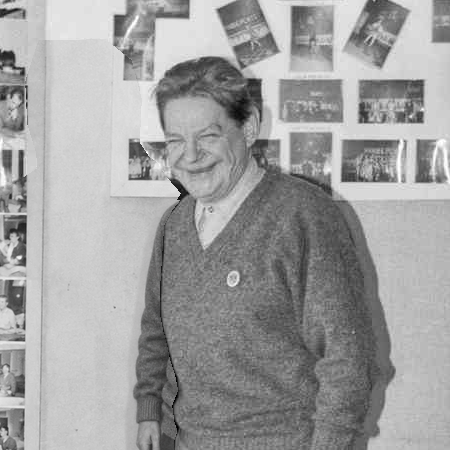
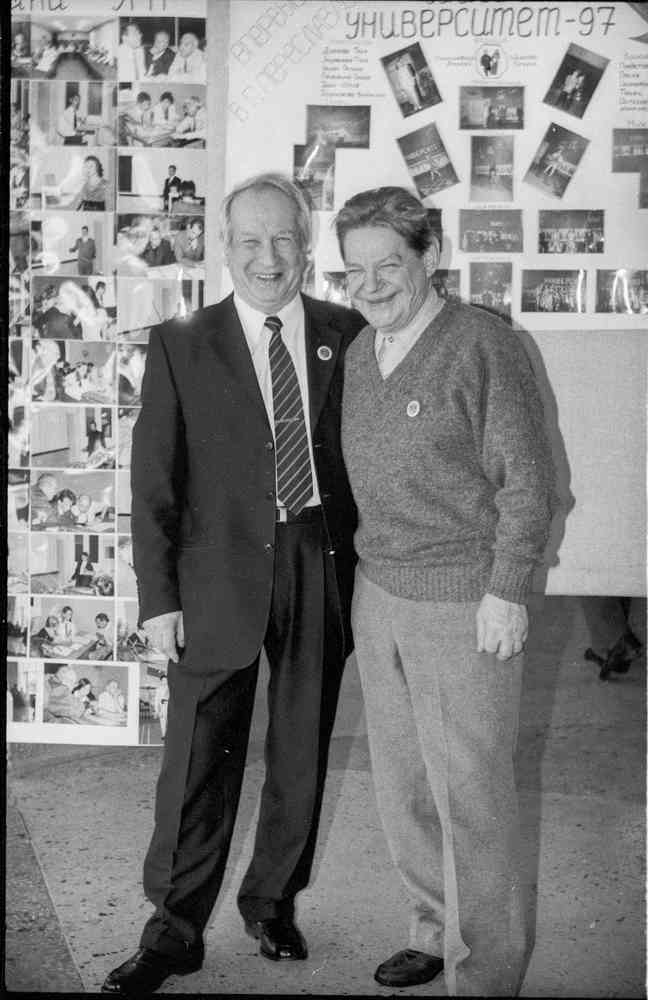
Biography
Dmitry Aleksandrovich Pospelov was born on 19 December 1932 in Moscow. In 1956 he graduated from the Faculty of Mechanics and Mathematics of Moscow State University with a degree in Computational Mathematics and began working at the Department of Computer Engineering of the Moscow Power Engineering Institute. Alongside teaching, he studied the theory of computing systems, automata and games, and many-valued logics.
In 1968 Pospelov moved to the Computing Centre of the Academy of Sciences of the USSR. He first headed a sector in the laboratory of large systems, and later the division of artificial intelligence problems. He worked at the Computing Centre of the Academy of Sciences of the USSR and of the Russian Academy of Sciences until 1998. From 1968 Pospelov was a professor at the Moscow Institute of Physics and Technology.
At the Computing Centre, artificial intelligence became one of the main fields of his research. Interest in how a person describes a situation, chooses a decision and reasons with incomplete information linked his work on management, logic and knowledge representation.
Situational management
In the late 1960s Pospelov developed an approach to the management of complex objects that became known as situational management. It was designed for tasks where not only numerical parameters matter, but also a description of what is happening: the state of the object, the relations between its parts, events and possible actions.
In such a system, the current situation is described as a situation and compared with known types of situations. For a familiar situation, a prepared decision can be chosen; for a new one, a transformation can be sought using rules and knowledge of the subject domain. This method makes it possible to include in the model the experience of a specialist who formulates decisions in words and rules, and not only in equations.
In the book “Situational Management: Theory and Practice” (1986), Pospelov consistently examined how to move from a description of an object to the choice of an action. He considered the language for describing situations, the completion of incomplete information, the classification of a situation and planning. In one of the examples, a production scenario links machine downtime to possible causes — the absence of a worker, a fault or a shortage of workpieces. Such connections help to organise the search for an explanation and a decision, although the fact of downtime itself does not make it possible to establish its cause automatically.
The book also shows the limit of simply adding facts: knowing that an object consists of several parts, one cannot, without additional conditions, transfer any property of the whole to each part. Inference requires rules that take account of the meaning of relations. In this way the problem of management connects with a more general question: what knowledge a system needs in order to interpret a message correctly.
The basis of the approach was semiotic, or logical-linguistic, models: they link a sign description of an object with decision-making procedures. In the 1970s, situational management methods were used in creating systems of operational dispatch management of complex objects, including a sea cargo port.
Knowledge and reasoning
Pospelov's research concerned how to represent knowledge in a computer so that a system could use it to solve problems. He was interested in the organisation of knowledge, approximate reasoning, dialogue systems and understanding. The question was not only one of storing information: it was also necessary to define relations between concepts and ways of obtaining new conclusions.
Works on applied semiotics studied sign models of subject domains. Such models make it possible to describe objects and events, their meanings and connections, as well as rules for transforming descriptions. This field combined methods of logic and sign theory with the tasks of management and artificial intelligence.
In the book “Logical-Linguistic Models in Management Systems” (1981), Pospelov set out an approach to decision-making using such models and techniques for implementing it on computers. The very formulation of the task is essential: knowledge about an object and methods of management is treated as the subject of a formal description with which a programme can work.
In the book “Modelling Reasoning. An Attempt at the Analysis of Thought Acts” (1989), he compared reliable and plausible reasoning, including induction, analogy and fuzzy inference. A separate part is devoted to inference in a knowledge base: rules of the “if — then” form, control over their application and semantic networks. Pospelov considers, for example, the search for a given fragment of a network and the transformation of the description found. Comparing these methods, the author shows how knowledge and inference rules help an intelligent system to make decisions.
Pospelov also developed pseudo-physical logics — formal means for modelling reasoning about time, space, actions and causal relations. They address the ideas that people use in everyday reasoning about the world. For example, when planning an action, a system needs to take into account not only the event itself but also what precedes it and what may follow it.
The joint book by E. Yu. Kandrashina, L. V. Litvintseva and D. A. Pospelov, “Representation of Knowledge about Time and Space in Intelligent Systems” (1989), examines how to describe spatial and temporal relations for the operation of an intelligent system. This is necessary, for example, when the order of events or the relative arrangement of objects affects the admissibility of an action. Pseudo-physical logics provide a formal language for such relations, in which inferences can be constructed.
Computing systems
One of Pospelov's early lines of work was the organisation of computations on several machines. The apparatus of tier-parallel forms that he developed helped to investigate which parts of a program can be executed simultaneously and how to distribute the work among machines. With its help, the distribution of programs, their division into parts and information exchange were studied.
The later development of this research was connected with the ideas of special processors for knowledge bases and logical inference. Pospelov led international projects to create prototypes of the LIVS and PAMIR computing systems, in which new architectures for artificial intelligence tasks were investigated.
The book “The Orchestra Plays Without a Conductor” (1984), written together with V. I. Varshavsky, discusses decentralised control. The authors consider systems whose parts take local decisions and coordinate actions through the environment or the exchange of information. Using examples of technical and organisational systems, they show why control does not always come down to commands from a single central body.
Scientific school and professional community
Pospelov's scientific school took shape during his years of work at the Moscow Power Engineering Institute. At the seminar on psychonics, specialists in computing technology and psychology discussed the tasks of modelling thinking and behaviour together. Among his students were Yu. I. Klykov, V. N. Vagin, G. S. Osipov and other researchers working in the field of control and artificial intelligence.
Pospelov took part in organising research on artificial intelligence at the Academy of Sciences of the USSR. In May 1989 he was one of the initiators of the creation of the Soviet Association for Artificial Intelligence and became its first president; later the association became the Russian one. From the founding of the journal “Artificial Intelligence News” in 1991, he was its editor-in-chief for many years.
Selected works
- “Logical-Linguistic Models in Control Systems” (1981) — on sign models for control tasks.
- “The Orchestra Plays Without a Conductor” (together with V. I. Varshavsky, 1984) — on the evolution of technical systems and their control.
- “Situational Management: Theory and Practice” (1986) — an exposition of the approach to control based on the description of situations.
- “Representation of Knowledge about Time and Space in Intelligent Systems” (together with E. Yu. Kandrashina and L. V. Litvintseva, 1989) — on the formal description of temporal and spatial relations.
- “Modelling of Reasoning. An Attempt at the Analysis of Thought Acts” (1989) — a study of the formal modelling of reasoning.
Memory
In 2022 the Russian Association for Artificial Intelligence and the Federal Research Centre “Computer Science and Control” of the Russian Academy of Sciences held the conference “Pospelov Readings”, timed to mark the 90th anniversary of the scientist's birth.
Why the Centre bears the name of D. A. Pospelov
The Centre bears the name of D. A. Pospelov as a sign of continuity with the national school of artificial intelligence, at whose origins the scientist stood.