
Subject of assessment
The area is headed by the Head of the AI Systems Safety Department Pavel Andreevich Zhdanovich, Candidate of Technical Sciences. The Department comprises the Assessment Methodology Division and the testing laboratory.
The subject of assessment is an artificial intelligence system taken together with its components: the model, the data on which it is trained and which it processes, the software environment, the interfaces for interaction with the user and the organisational measures for managing it. The criteria and procedures of assessment are set out in the Methodology for the Expert Assessment of Artificial Intelligence Systems, version 1.0, approved by Order of the Director No. 40 of 15 October 2026.
Risk classes
Systems are divided into four risk classes
Classes in ascending order of the possible consequences of a failure or error of the system
Minimal risk
Systems whose errors do not entail significant consequences for people and organisations.
Limited risk
Systems whose errors lead to inconvenience or financial losses that can be remedied without harm to the rights of citizens.
Increased risk
Systems that influence decisions on rights, duties, access to services or the safety of production processes.
Critical risk
Systems whose errors may entail harm to life and health, significant damage to infrastructure or irreversible consequences for the rights of citizens.
The risk class determines the scope of the materials submitted, the composition of the testing and the need for re-assessment when the system is changed. The risk class is determined by the AI Systems Safety Department after the application is registered and is communicated to the applicant together with the testing programme.
Testing laboratory
The testing laboratory of the AI Systems Safety Department carries out checks whose results are used in expert opinions. A specialist from the laboratory works in the expert group for the AI system; the test report is attached to the expert review materials.
What is checked
- the accuracy and stability of the system's results on control sets;
- resistance to distorted, incomplete and atypical input data, as well as to deliberate influences on the input data;
- the reproducibility of results on repeated runs and when the model version changes;
- the conformity of the system's behaviour with its stated purpose and limitations of use;
- the completeness of logging of the system's actions and the possibility of subsequent analysis of its decisions.
Test benches
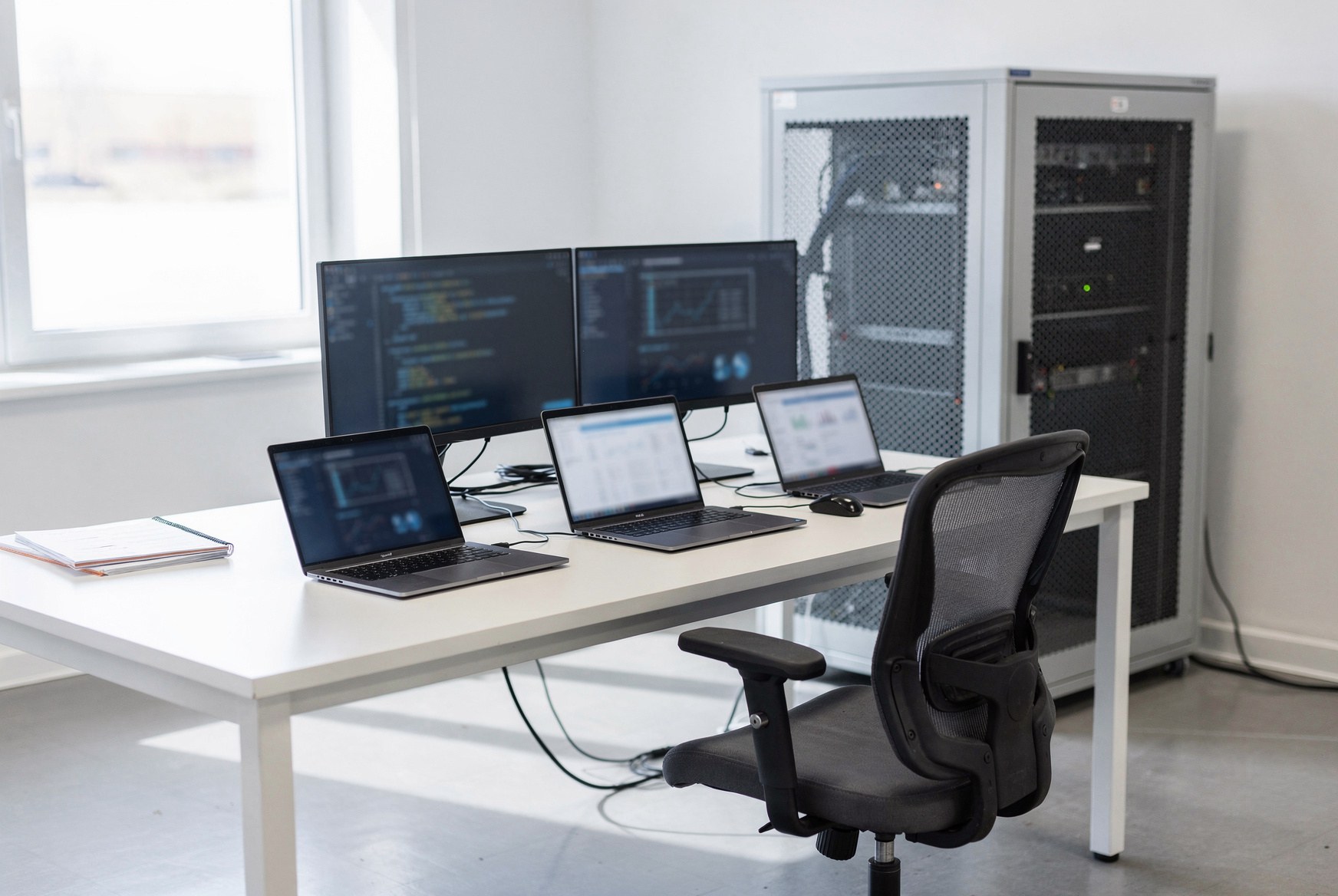
The laboratory works on two types of bench. On the local testing bench, the system submitted by the applicant as software is deployed in an isolated environment for the duration of the testing; external network connections are disabled unless the testing programme provides otherwise. On the remote testing bench, a system is checked that remains with the right holder and is accessible through an agreed interface; all requests and responses are recorded on the laboratory's side. To compare means of detecting synthetic content, a separate bench is used with a single procedure for launching all the means being compared.
Control sets and their storage
The control sets of tasks and data are formed and maintained by the laboratory, including sets for assessing large language models in Russian. Each set consists of two parts. The open part is described in the testing programme, and the applicant can use it to verify the results independently. The closed part is not transferred to applicants or developers and is used only in testing: in this way the system cannot be tuned to tasks known in advance. The closed part is kept in a separate secure storage facility of the laboratory and is replenished at least once a year; on repeated testing of the same system, an updated sample is used.
Access
Access to the closed part of the sets and to the applicant's materials is held by laboratory staff included in a list approved by the Head of the AI Systems Safety Department. Authorisation is drawn up in writing for a specific expert review and ends after its completion. The experts of the group receive the testing results and the report, but not the closed tasks themselves. Laboratory staff sign a declaration of absence of conflict of interest for each system.
Logging and reproduction
Every run is recorded in the testing log: the system version, the set version, the launch parameters, the date and time, the person performing it, and the result obtained. After the report is signed, the log records are not changed. The report contains information sufficient for a repeat run; repeat testing is carried out by another laboratory worker, and in the cases provided for by the Methodology the group's conclusions are checked by an expert who is not a member of the group. Access to the storage of closed sets is also recorded in the log.
Handling of the applicant's data
The applicant's materials are used and stored in accordance with section 14 of the Regulation on the Procedure for Conducting Expert Review and section 15 of the Methodology.